
The Strategic Shift: Why E-Commerce and Marketplace Platforms are Shifting to Stablecoins for Global Settlement
For years, moving money across borders has felt like the only part of e-commerce stuck in the past. While we can ship a product halfway around the world with real-time tracking, the actual payment often disappears into a "black hole" of correspondent banks for days.
In 2026, the conversation has changed. Stablecoins are no longer just a "crypto" innovation. They have become a high-performance tool for global businesses to move capital without the typical wait times or hidden fees of traditional banking.
Eliminating the Liquidity Gap
The biggest headache for any high-volume merchant is the "liquidity gap." While digital storefronts have evolved at breakneck speed, the underlying payment infrastructure has struggled to keep pace with a 24/7, borderless economy. This disconnect is most visible in the "liquidity gap" created by traditional banking delays.
In traditional systems, funds are often trapped in transit for three to five days, preventing high-volume merchants from redeploying capital immediately. By utilising blockchain rails for payments, businesses can achieve near-instant settlement. This allows a merchant to sell an item and have usable capital in their treasury within minutes, transforming cash flow management from an operational hurdle into a strategic advantage for global expansion.
Streamlining Payouts for the Global Gig Economy
As marketplaces expand into the "Super-App" and gig economy sectors, they increasingly rely on a massive, distributed workforce of drivers, creators, and vendors. Coordinating payouts to thousands of individuals across different countries via traditional wires is an administrative burden, often hindered by opaque tracking and high banking fees.
Stablecoins enable platforms to execute programmable mass payouts through a single API integration. Because these assets move across borderless networks, a recipient in a different region can receive their earnings almost instantly, removing the need for expensive intermediary banks and significantly improving cash flow.
Hedging Against Invisible Currency Loss
Beyond speed, the shift toward stablecoins is driven by the need to capture lost margins. Cross-border e-commerce often loses a significant percentage of every sale to currency conversion fees and the hidden markups of intermediary banks.
Stablecoins act as a "universal translator" for value, allowing marketplaces to establish direct payment corridors. By accepting local currency and settling in a stablecoin at transparent, mid-market rates, businesses can eliminate the "USD-middleman." This ensures that more of the transaction value remains with the platform and the merchant rather than being absorbed by traditional financial institutions.
Expanding the Global Addressable Market
Finally, the move toward stablecoins represents a massive opportunity for market expansion. Traditional credit-based e-commerce effectively overlooks markets with high mobile penetration. By integrating stablecoin-native checkout options, marketplaces open their doors to these "digital-native" customers. This allows users to participate in global trade using mobile wallets, significantly increasing a platform's potential customer base without the fraud risks and high "minimum transfer" hurdles associated with international credit card processing.
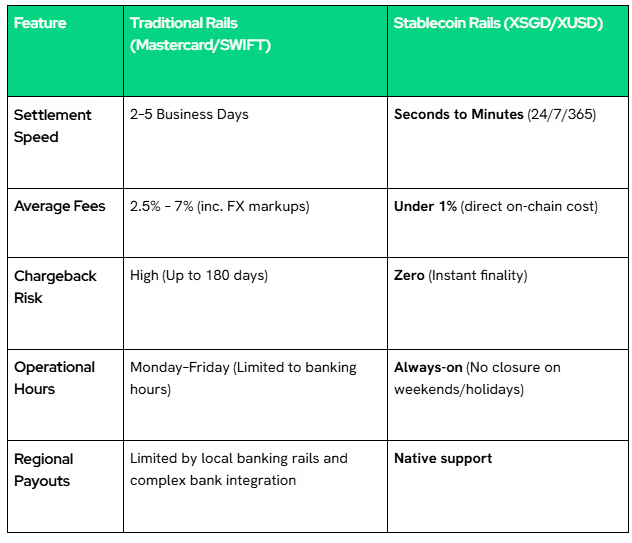
Efficiency Benchmarks: Traditional vs. Stablecoin Settlement
For global enterprises, the choice between traditional rails and stablecoins often comes down to the bottom line. Below is a comparison of typical performance metrics:
Real-World Use Cases
Major global and regional players are already starting to integrate stablecoins into their payments:
- Shopify & Stripe Global Checkout: In late 2025, Shopify deepened its partnership with Stripe and Coinbase to enable USDC payments on the Base network across 34 countries. Merchants receive their local currency by default with zero exchange fees, or they can choose to hold the stablecoin directly in their treasury.
- Grab & StraitsX Web3 Integration: Grab and StraitsX recently signed an MOU to develop Web3-enabled wallets within the Grab app. This uses Purpose Bound Money (PBM) to allow users to hold and spend stablecoins like XSGD and XUSD for everyday services, providing merchants with instant settlement and reduced transaction costs.
- Amazon’s Tokenised Payouts: Amazon has collaborated with StraitsX and NTT Digital to explore the use of stablecoins for settling tokenised accounts receivable. This pilot allows sellers to access liquidity for their sales nearly instantly, rather than waiting for the standard 14-day payout cycle, significantly improving vendor cash flow.
- Dtcpay powers stablecoin payments at Metro: Shoppers can now choose to pay directly with their preferred stablecoin (USDT, USDC, FDUSD, or WUSD) at Metro, making it easier and more convenient to use digital assets in their daily lives. Payments are also done seamlessly and securely without the concerns of price fluctuations.
Powering Your Business with StraitsX
As the digital economy moves toward a standard of instant, programmable value, integrating stablecoins is the key to maintaining a competitive edge. Businesses can now access these high-efficiency rails through a range of StraitsX stablecoin solutions, which provide a regulated, institutional-grade gateway to the digital asset economy. By integrating the StraitsX Payment and Payout APIs, businesses can automate the entire lifecycle of a transaction, from accepting a customer's stablecoin payment to managing treasury across multiple chains.
Contact our team here to learn more about the possibilities of unlocking stablecoin payments for your e-commerce and marketplace platforms.
.avif)
.avif)
