Stablecoins have quietly become one of the most consequential financial innovations of the past decade. What began as a crypto-native tool for trading has evolved into programmable settlement infrastructure powering cross-border payments, treasury operations, remittances, and increasingly, card-based spending.
As stablecoin-linked cards gain traction globally, the question facing investors and fintech operators is no longer whether adoption will continue, but where the next phase of scalable growth will concentrate.
The data increasingly points to Asia.
Stablecoins Have Reached Global Settlement Scale
The foundation for stablecoin card growth is the scale of the underlying settlement layer.
In December 2025, the trailing 30-day average for adjusted stablecoin transaction volume reached approximately $3.5 trillion, according to research from ARK Invest. That figure is roughly 2.3 times the combined transaction value of Visa, PayPal, and global remittances combined. This signals that stablecoins are no longer peripheral instruments, they are operating at payment-network scale.
At the same time, global stablecoin supply has surpassed $250 billion, reflecting growing integration into the financial ecosystem. Visa has publicly highlighted accelerating interoperability initiatives, including over 130 stablecoin-linked card programs across more than 40 countries and stablecoin settlement volume reaching a $3.5 billion annual run rate.
However, transaction volume alone does not equate to economic payment usage.
Research from McKinsey & Artemis Analytics estimates that approximately $390 billion in annual stablecoin payments were executed in 2025 when isolating real economic activity from trading and DeFi transactions. Importantly, around 60% of that volume, approximately $226 billion, was B2B activity, underscoring the role of stablecoins in treasury management, supplier payments, and cross-border settlement.
Stablecoins are increasingly settling commerce, not just moving speculative capital.
Asia Leads in Stablecoin Payment Volume
Geographic data indicates that Asia accounts for the largest share of global stablecoin payment volume.
Of the estimated $390 billion in annual stablecoin payment volume, approximately $245 billion, or 60%, originated from Asia in 2025. By comparison, North America accounted for roughly $95 billion and Europe approximately $50 billion.
Activity is concentrated in major financial hubs including Singapore, Hong Kong, and Japan, which serve as anchors for regional and global settlement flows. Corridor analysis by Artemis Analytics further identifies the Singapore–China corridor as the most active globally for stablecoin transactions, reinforcing Asia’s role as a structural liquidity center.
Broader blockchain data supports this acceleration. According to Chainalysis, APAC recorded a 69% year-over-year increase in on-chain value received in the 12 months ending June 2025. Total regional transaction volume expanded from $1.4 trillion to $2.36 trillion within a single year. Monthly activity has remained structurally elevated above $185 billion.
Asia isn’t merely participating in stablecoin growth. It is where majority of real-world stablecoin payments are coming from.
Stablecoin-linked Cards Are Expanding on Top of This Base
Stablecoin-linked cards represent the interface layer built on top of programmable settlement liquidity. They allow holders to spend stablecoins directly with merchants globally without first converting through traditional banking rails.
Globally, this segment is growing rapidly. Artemis estimates that monthly crypto card volumes increased from approximately $250 million in early 2023 to over $1.5 billion by late 2025. McKinsey estimates total stablecoin-linked card spending reached $4.5 billion in 2025, representing 673% year-over-year growth. On-chain tracking by Dune Analytics indicates total crypto card spending increased approximately 420% during 2025 alone.
While stablecoin-linked card volumes remain small relative to traditional card networks, their growth trajectory is steep. More importantly, card expansion tends to accelerate where underlying stablecoin payment activity is already dense.
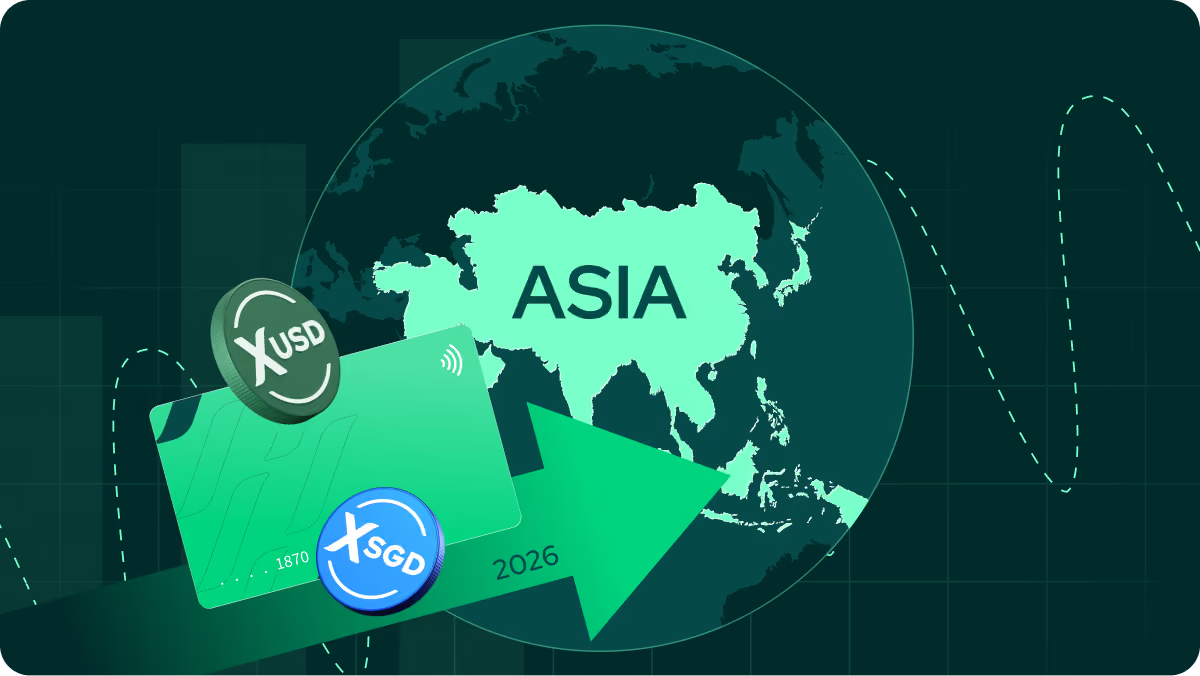
Because Asia accounts for approximately 60% of global stablecoin payment origination, it is structurally positioned to experience disproportionate growth in stablecoin-linked card adoption as interoperability deepens.
In emerging Asian markets where access to dollar liquidity can be constrained, stablecoin-linked cards offer functional access to USD-denominated balances for travel, online commerce, and everyday spending. In trade-heavy economies, they reduce settlement friction and improve working capital efficiency for exporters, SMEs, and digital platforms.
The demand driver is not speculative consumer behavior. It is financial access and operational efficiency layered on top of programmable liquidity.
Scaling in Asia Requires Infrastructure, Not Just Issuance
Asia’s structural lead in stablecoin payment origination does not automatically translate into simple market entry.
The region combines multiple currencies, diverse regulatory regimes, high cross-border trade intensity, and fragmented banking systems. Launching a stablecoin-backed card program therefore requires more than card network integration or wallet functionality.
Sustainable scale depends on coordinating stablecoin issuance and redemption, regulated fiat on- and off-ramps, multi-currency treasury management, cross-border settlement alignment, card network clearing, and ongoing compliance monitoring across jurisdictions.
Many card programs operate primarily at the distribution layer. In Asia’s multi-market environment, however, distribution without deep infrastructure can create liquidity fragmentation, regulatory exposure, and settlement inefficiencies.
True scale requires infrastructure that connects stablecoin liquidity directly to compliant financial rails across jurisdictions. Rather than sitting above the settlement layer, infrastructure-led architectures operate beneath it, enabling programmable dollar flows to move seamlessly between on-chain networks and regulated financial systems.
And this is where Asia’s advantage compounds.
Because the region already originates roughly 60% of global stablecoin payment activity, the next phase of stablecoin-linked card expansion will not be driven solely by product innovation. It will be driven by settlement integration.
In 2026 and beyond, the competitive question will not be who can issue a card. It will be who can anchor programmable liquidity into Asia’s financial architecture, securely, compliantly, and at scale.
.jpg)