Fiat vs Stablecoin Settlement for OTC Desks

For businesses engaging in crypto markets through OTC desks, settlement is no longer just an operational detail. It has become a strategic consideration, one that affects cash flow, risk management, and how quickly capital can be put to work.
Traditionally, OTC trades have settled via fiat rails. It’s familiar, well understood, and anchored in existing banking relationships. But as crypto markets operate around the clock, many finance teams are beginning to question whether fiat settlement alone is still fit for purpose.
When Fiat Works, and Where It Starts to Strain
Fiat settlement offers a sense of certainty. Funds move through regulated banks, accounting treatment is straightforward, and compliance teams are comfortable with the process. For many businesses, this remains an important foundation.
Yet the realities of OTC trading often expose its limitations.
Banking cut-off times, cross-border transfer delays, and intermediary fees can slow down settlement, sometimes by days. When markets move quickly, these delays can translate into missed opportunities, idle capital, or increased counterparty risk. For CFOs and finance ops teams, this creates friction between trading intent and actual execution.
The question becomes less about trust, and more about efficiency.
Why Stablecoin Settlement Is Gaining Ground
Stablecoins introduce a different settlement paradigm. Instead of relying solely on traditional banking rails, value moves on-chain, instantly, transparently, and without regard for time zones.
For OTC desks and their clients, this opens up new possibilities:
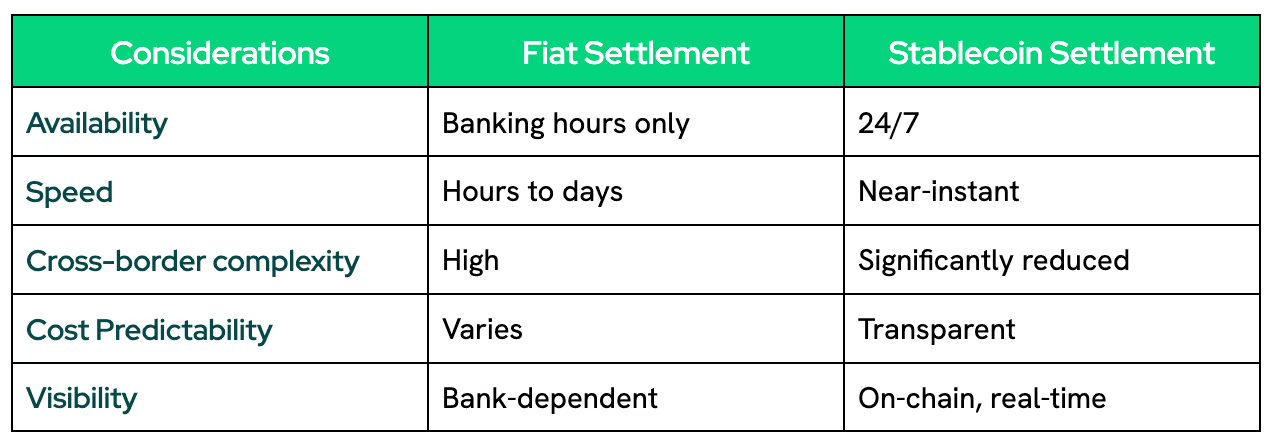
- Settlement can happen 24/7, not just during banking hours
- Trades reach finality in minutes, not days
- Capital remains immediately available for redeployment
- Cross-border transactions avoid layers of FX and correspondent banking
For finance teams used to reconciling delays and workarounds, the appeal is simple: fewer moving parts, greater control over liquidity, and clearer visibility over where funds sit at any point in time.
The Role of Regulated Stablecoins in OTC Settlement
However, not all stablecoins are suitable for business use. For CFOs and business owners, questions around reserves, redemption, and regulatory oversight are critical.
This is where fully-reserved, fiat-pegged stablecoins such as XSGD and XUSD come into play.
StraitsX, a Major Payment Institution (MPI) licensed by the Monetary Authority of Singapore (MAS), and acknowledged by the MAS as substantively compliant with the Single-Currency Stablecoin (SCS) framework, is the issuer of XSGD and XUSD, which are designed to support real-world financial operations, including OTC trade settlement. These stablecoins allow businesses to hold and move value on-chain while maintaining exposure to familiar fiat currencies, SGD and USD.
In practice, OTC desks and their clients use XSGD and XUSD to:
- Settle crypto trades efficiently without waiting for bank transfers
- Manage on-chain liquidity in SGD or USD terms
- Reduce friction when transacting with overseas counterparties
- Streamline post-trade reconciliation with transparent on-chain records
The result is faster settlement without sacrificing regulatory clarity or operational discipline.
A Comparison Finance Teams Care About
For many businesses, the decision isn’t binary. It’s about choosing the right tool for the right moment. When viewed through a finance and operations lens, the differences are clear:
The Hybrid Reality for Modern Businesses
Increasingly, businesses working with OTC desks are adopting a hybrid approach.
Fiat rails continue to play an essential role in onboarding, compliance, and redemptions. Stablecoins, meanwhile, are used for what they do best: fast settlement, liquidity movement, and cross-border efficiency.
This model allows finance teams to stay aligned with internal controls while giving traders and operators the flexibility they need in a 24/7 market.
Rethinking Settlement as a Strategic Lever
As digital asset markets mature, the competitive edge will no longer come solely from pricing or access to liquidity. It will come from how efficiently capital moves.
For business owners, CFOs, and finance ops leaders, stablecoin settlement is less about replacing fiat, and more about complementing it.
By using stablecoins such as XSGD and XUSD issued by regulated issuers, settlement can be faster, more flexible, and better aligned with how crypto markets actually operate.
For businesses exploring off-exchange execution or looking to trade crypto and stablecoins at scale, learn more about StraitsX OTC here.
Related Post
.avif)