- Digital wallets like Apple Pay and Google Pay are a baseline expectation for modern card programs, delivering a frictionless payment experience that dramatically improves card activation and overall usage rates.
- Enabling Apple Pay, Google Pay and Samsung Pay for a card programme requires underlying tokenisation infrastructure, primarily through the Visa Token Service (VTS), alongside an In-App Provisioning API to securely replace sensitive card credentials with a secure, encrypted digital token to ensure institutional-grade fraud protection.
- To go live, card issuers must navigate a strict 3-Stage certification process covering business alignment, production testing with real funds, and compliance validation
- For platforms looking to scale rapidly across Asia, partnering with StraitsX offers a reliable, streamlined solution through managing complex certifications, tokenization, and compliance frameworks required by card networks and tech providers.
Digital wallets have fundamentally transformed the way consumers interact with their money, becoming a baseline expectation in everyday commerce. For fintech platforms, digital asset managers, and Web3 businesses launching modern card programs, supporting mobile wallets is no longer a luxury feature. When users sign up for a new card, they expect to begin transacting immediately online, in-app, and at physical terminals.
By enabling Apple Pay,Google Pay and Samsung Pay, card issuers deliver a frictionless, modern payment experience that dramatically improves card activation and overall usage rates. However, bringing mobile wallet capabilities to a card program requires a sophisticated mix of underlying infrastructure and navigation through rigorous card scheme rules.
As the card issuance infrastructure provider bridging traditional finance and internet-native money in APAC, StraitsX has pioneered the path for businesses to launch wallet-ready card programs efficiently. Here is a comprehensive look at how to enable Apple Pay, Google Pay and Samsung Pay for your card program.
Tokenisation Infrastructure via Visa Token Service
Before a physical or virtual card can be provisioned into a mobile device, the underlying issuing infrastructure must support advanced tokenisation. When a user registers their card with a digital wallet, sensitive cardholder credentials, such as the 16-digit Primary Account Number (PAN), expiration date, and CVV, are replaced by a unique, secure digital identifier known as a token.
StraitsX powers this seamless integration through the Visa Token Service. By leveraging network tokenisation, sensitive user data is never stored on the device or exposed to merchants during a transaction. Instead, the encrypted token is used to safely process payments throughout the entire lifecycle. This setup satisfies the strict security guidelines mandated by tech giants and global card schemes, providing institutional-grade fraud protection while maintaining an uninterrupted payment experience.
In-App Provisioning API and the APAC Edge
A critical factor in driving immediate card adoption is how effortlessly a card can be added to a digital wallet. Traditionally, users had to manually enter their 16-digit card details, which introduced friction and heavily impacted card activation rates. Modern card programs bypass this entirely by using advanced Apple Pay, Google Pay and Samsung Pay provisioning powered by push technology.
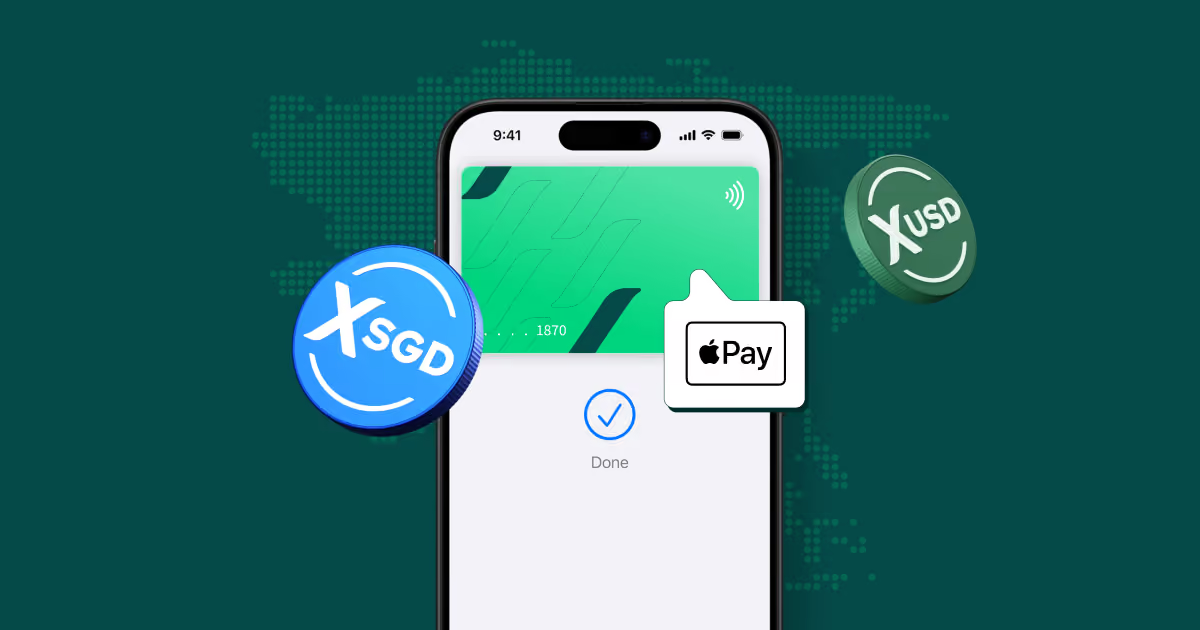
Through an In-app provisioning API, fintech platforms allow their users to add a newly issued card to their digital wallet with a single tap, completely within the partner's native application environment. The user never needs to leave your app or type out sensitive data. Furthermore, features like Apple Wallet Extensions allow users to initiate card addition directly from the native wallet app, securely authenticating via Face ID or Touch ID before the card is instantly provisioned.
Leveraging this frictionless onboarding is a massive competitive differentiator. In fact, StraitsX stands out as the card issuer in APAC allowing Apple Pay, Google Pay and Samsung Pay integration and In-App provisioning for stablecoin-backed card programs. By handling these complex capabilities natively, StraitsX allows platforms like OKX and RedotPay to offer their users instant real-world spending power from day one, dramatically increasing transaction volume.
Navigating the 3-Step Certification Process
Having the technical tokenisation infrastructure ready is only the first step. Before any card can go live in a customer’s wallet, the program must pass a rigorous, highly structured certification process to validate end-to-end security, provisioning logic, and wallet interoperability.
Unlike standard web APIs, this is a multi-layered undertaking that introduces production-level dependencies and operational constraints. The certification process for enabling digital wallets is a structured, three-stage journey designed to ensure security and interoperability:
- Stage 1: Business Initiation and Alignment - Focuses on defining payment flows, securing technical certification slots with external test houses, and aligning all branding and communications with network rules.
- Stage 2: Technical Integration and Live Production Certification - Unlike typical software testing, this occurs in a live production environment. It validates the full card lifecycle using real funds and devices under strict risk controls managed by StraitsX.
- Stage 3: Compliance Assessment and Scaling - The final phase verifies operational readiness, customer support channels, and trigger-based communications before approving a structured public rollout.
Driving Everyday Contactless Payments
Once certification is complete and your cards are successfully provisioned, your card program natively unlocks a suite of powerful, multi-channel payment capabilities that fit seamlessly into your users' daily routines:
- Contactless Payment: Users can experience tap-and-go convenience at millions of merchants worldwide using Near Field Communication (NFC) via their smartphones or wearables, like smart rings and watchstraps.
- In-App and Web Purchases: Fast, secure checkouts on mobile apps and e-commerce browsers (like Safari or Chrome) without forcing the user to re-enter card details.
- Express Transit Payments: Users can simply tap their device at supported transit turnstiles to commute seamlessly without needing to unlock their device or authenticate each time.
Partnering for Success with StraitsX
Building the infrastructure, managing tokenisation layers, and navigating the complex compliance frameworks required for Apple Pay, Google Pay and Samsung Pay entirely in-house is an intensive, resource-heavy undertaking. Beyond the technical build, issuers must also manage extensive certification, testing, and operational requirements to ensure a secure and compliant launch.
For fintech platforms looking to scale rapidly across Asia, partnering with StraitsX offers a proven path to market without compromising on quality, compliance, or operational readiness. Backed by our Visa BIN sponsorship and regulated stablecoin-native infrastructure, we manage the end-to-end certification, technical validation, and operational testing required by card networks and tech providers.
With a streamlined implementation timeline of just 2-3 months, StraitsX provides a full-stack solution encompassing virtual, physical, and native wallet provisioning alongside 1:1 fiat-to-stablecoin settlement with zero handling fees. By leveraging a trusted, regulated partner with established infrastructure and expertise,your team can focus entirely on what matters most: building an exceptional user experience.
Ready to bring your stablecoin-linked card program to life in Asia? Speak with our team today.
.jpg)