.avif)
Key Highlights
- Full-stack card issuing combines card creation and transaction processing under a single provider to eliminate multi-vendor friction and streamline operations.
- This consolidated architecture enables features like digital wallet provisioning and wearable payments without waiting on third-party timelines.
- Operating with end-to-end infrastructure allows platforms to reduce reliance on additional intermediaries, leading to faster settlements and more efficient capital management.
- Compliance frameworks and required certifications help ensure alignment with evolving network requirements and support service continuity for users.
- Businesses gain a scalable foundation that supports launch through sponsorship while offering a clear pathway toward full program independence.
As stablecoin card programs grow across APAC and global markets, early discussions usually focus on how quickly a card can launch, fee splits, and user acquisition. However, the technical operations running behind these programs are changing.
The StraitsX full-stack card issuance solution is designed specifically to meet this structural shift, providing the unified infrastructure businesses need to manage modern payments at scale. By aligning your setup with our stablecoin card issuance solutions from day one, your platform gains the foundation required to capital efficiency and long-term user retention.
With this foundation in place, winning card programs are no longer differentiating themselves just on launch speed or low upfront costs. Instead, long-term success belongs to businesses that prioritise reliable infrastructure, expanded capabilities, and tighter system control. For scaling fintechs, embedded finance providers, Web3 platforms, and brands building payment ecosystems, success increasingly depends on choosing an issuer built for global scale, especially as the broader market matures.
How Has the Stablecoin Card Market Matured?
The card issuing landscape has evolved due to meet rising user expectations for instant, digital-first payment experiences.
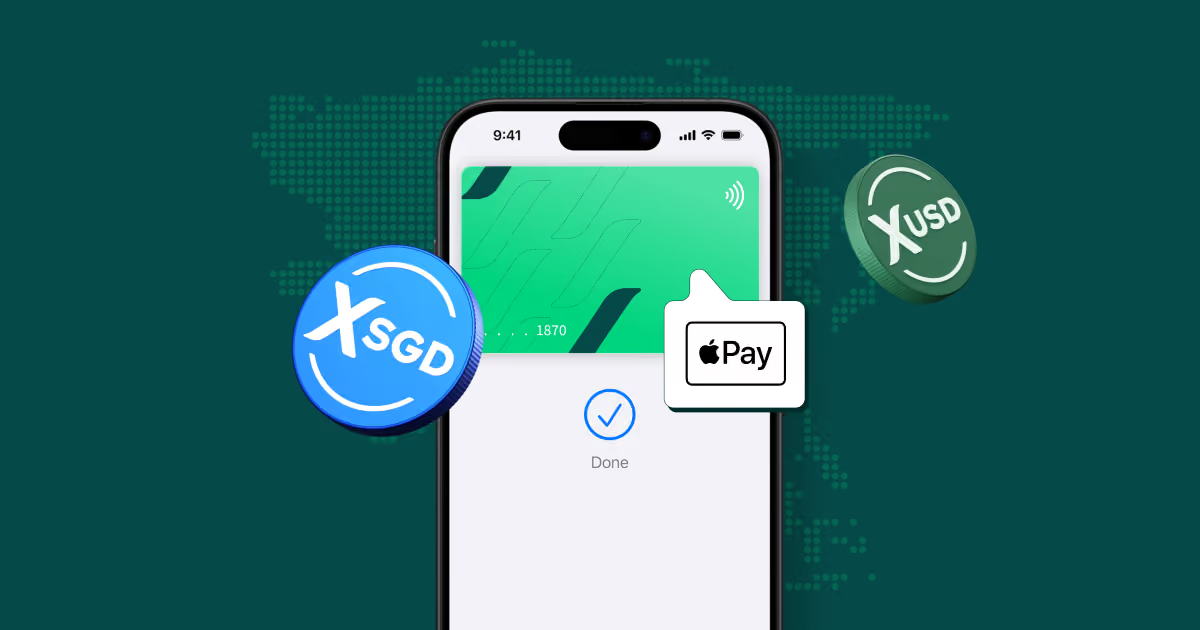
Instead of relying solely on physical cards, users now demand instant utility, expecting virtual cards to work instantly with Apple Pay, Google Pay, and Samsung Pay, while requiring tokenised payment experiences across mobile devices, wearables, and emerging connected ecosystems.
Concurrently, card schemes, global wallet ecosystems, and regional regulators are enforcing stricter compliance, certification, and operational governance. As a result, infrastructure decisions that were once considered back-office concerns are becoming strategic business decisions.
Launching a card program is no longer the primary challenge. The bigger consideration is whether the underlying infrastructure can support the next generation of payment experiences.
What Is Full-Stack Issuing and Why Does It Matter?
Full-stack issuing is an operational model where a single partner serves as both the card issuer and the payment processor, giving businesses direct control over system performance, SLAs, and features without relying on external intermediaries. When a single infrastructure stack can manage both layers, it removes the friction of managing multiple vendors. Handling processing natively, including local onshore settlement where required, removed middleman layers. This improve authorisation reliability, speeds up settlement windows, and lowers overall transaction costs.
In addition, multi-provider models require a brand to coordinate across a variety of internal and external stakeholders before reaching the card network. By contrast, a full stack model consolidates these layers into a singlpe point of contact between your business and the network.
A full-stack model also creates the foundation for innovation. Advanced capabilities such as Apple Pay, Google Pay, Samsung Pay, wearable payments, tokenisation services, and emerging AI-driven payment experiences require tight integration between issuing and processing systems.
As payment experiences become more sophisticated, a fragmented infrastructure can create operational and product constraints. Platforms that combine orchestration, flexibility, and control are better positioned to adapt.
Why Is Compliance Now a Competitive Advantage?
Compliance has become a competitive advantage because card schemes now require strict operational certifications that only highly regulated infrastructure partners can seamlessly maintain.
Navigating these complex regulatory frameworks and card scheme rules is no longer just an administrative task. It is a critical prerequisite for cross-border expansion. Major wallet ecosystems, card networks, and regulators are increasingly reinforcing rigorous compliance, data protection, and operational audits before granting tokenisation capabilities.
This operational bar is exceptionally clear when deploying mobile wallet capabilities. Enabling Apple Pay, Google Pay, and Samsung Pay at scale requires more than technical connectivity. It requires adherence to certification standards, security controls, operational procedures, and ongoing programme management requirements. While some providers focus primarily on accelerating launch timelines, long-term success increasingly depends on building infrastructure that can evolve alongside changing standards and regulatory expectations.
Partnering with a card issuance provider who invests in certification, operational controls, and compliance-led operating models allows your brand to have more sustainable growth and focus on your user experience.
How Do New Payment Form Factors Impact Card Infrastructure?
New payment form factors impact card infrastructure by requiring systems to shift away from physical cards toward digital-first architectures built entirely around secure tokenisation for diverse connected devices.
The payment experience is rapidly expanding beyond physical plastic as retail consumers and business users expect payments to be seamlessly embedded into devices, wearables, connected products, and digital experiences. Today, watches, rings, fitness devices, and other wearable devices are already becoming standard components of the mainstream payments ecosystem.
Looking ahead, the horizon includes AI-powered agents and autonomous payment experiences that may introduce entirely new transaction models. Supporting these innovations requires an underlying infrastructure designed for tokenisation and digital-first payment experiences from the outset.
Ultimately, the ability to provision credentials securely across multiple devices and channels will become an important differentiator for issuers looking to remain relevant as payment behaviours continue to evolve.
Why Should Program Managers Seek a Path to BIN Ownership?
Program managers should seek a path to BIN ownership to secure full independence over their economics, data visibility, and product direction as their transaction volumes grow.
An emerging trend across the industry is the growing desire among fintechs and program managers to gain greater ownership of their payment infrastructure. While BIN sponsorship provides a valuable route to market, many successful programs eventually seek increased control over their margins, user experience, and strategic direction.
This is why migration pathways toward BIN ownership are becoming increasingly important. The right infrastructure partner should not only support a program's initial launch but also provide a clear roadmap toward greater independence, scalability, and brand control as the business matures. For growing fintechs and enterprise platforms, infrastructure decisions made today will significantly impact product flexibility and commercial outcomes tomorrow.
The table below outlines how operational capabilities, settlement efficiencies, and feature speeds shift as a card program transitions away from legacy configurations to a modern infrastructure model:
How Is StraitsX Building for This Future?
StraitsX provides a full card issuing and processing stack built with long-term scalability, compliance, and payment innovation in mind from day one.
Instead of relying on multiple third-party layers, our infrastructure is engineered to support modern, high-volume payment experiences across digital assets, embedded finance and global fintech use-cases.
By controlling the complete stack, we remove operational friction and give both B2B and B2B2C platforms full visibility over their transaction lifecycles.
Our infrastructure is built to deliver:
- Certified wallet provisioning across Apple Pay, Google Pay, and Samsung Pay.
- Support for tokenised payment experiences and emerging wearable form factors
- Direct card transaction processing featuring T+0 domestic settlement and T+2 international settlement for optimised capital efficiency.
- Greater operational visibility and settlement efficiency through integrated processing capabilities
- A structured migration framework that supports a predictable transition to independent, direct BIN ownership for organisations seeking long-term independence.
- A compliance-first operating model built for globally regulated, scalable card programs
Looking to Switch Issuers?
We work with fintechs and digital asset companies evaluating alternatives to their current card issuing setup, particularly where mobile wallet support, operational reliability, or regional coverage have become limiting factors.
If your growth is currently constrained by settlement delays or fragmented multi-vendor integrations, your platform should not have to stall.
Discover how to anchor your business to our card issuance infrastructure to bypass these bottlenecks, or speak with our team today to design a card program built for long-term scale and independence.
.jpg)