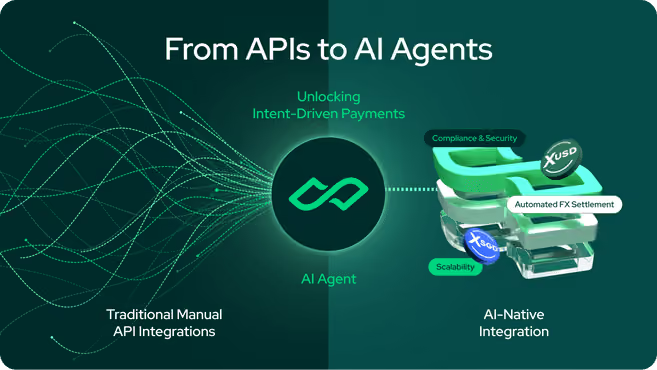
For more than a decade, APIs have underpinned the growth of modern financial services. They have enabled programmability, accelerated product development, and expanded access to payments infrastructure across markets.
While these advancements have been significant, the reality of payments integration remains complex. For many developers, implementing and scaling payment flows continues to require substantial time, coordination, and manual effort.
As development workflows evolve, this gap between what APIs promise and what integration requires is becoming more apparent. At the same time, AI agents will begin to initiate payments on behalf of users, shifting payments from user-driven actions to agent-driven execution.
Payments integration remains operationally intensive
In practice, integrating payments infrastructure involves more than connecting to a set of endpoints.
Developers are often required to navigate multiple layers of documentation, onboarding requirements, dashboard configurations, and compliance guidelines. While each component may be well-defined, the operational context required to implement them is distributed across systems, introducing friction during integration and scaling.
Payments systems must also account for currency conversion, settlement timing, regulatory requirements, and local payment behaviours, particularly in Southeast Asia where fragmentation is the norm.
APIs provide access to functionality, but do not fully abstract this operational complexity.
AI is reshaping development workflows
Tools such as ChatGPT, Gemini and Claude are increasingly integrated into developer workflows, enabling code generation, iteration, and testing through natural language interfaces. Development is moving from linear implementation toward intent-driven workflows, where developers describe outcomes and refine results iteratively. Documentation is no longer the sole interface to infrastructure. Natural language is becoming part of the integration layer itself.
This shift places new demands on APIs, which must be interpretable and executable by AI systems. However, agentic payments remain early-stage, and the immediate opportunity is not system overhaul, but removing practical blockers such as authentication, payment method selection, permissions, website access, and compliance.
A structural mismatch in current API design
Most payment APIs were designed for human developers. They assume contextual understanding and manual orchestration of workflows. While functional, this introduces inefficiencies in AI-assisted environments.
AI systems are constrained by how clearly APIs express intent, dependencies, and outcomes. Fragmented or context-heavy APIs increase translation overhead between intent and execution. As a result, faster development does not necessarily reduce integration complexity.
From API-first to agent-first systems
A shift is emerging toward agent-first systems, where infrastructure is built for both human and machine interaction.In this model, developers or AI agents specify outcomes, and the system orchestrates execution. This reduces manual coordination and increases abstraction across workflows. Within payments, this is the foundation of agentic payments.
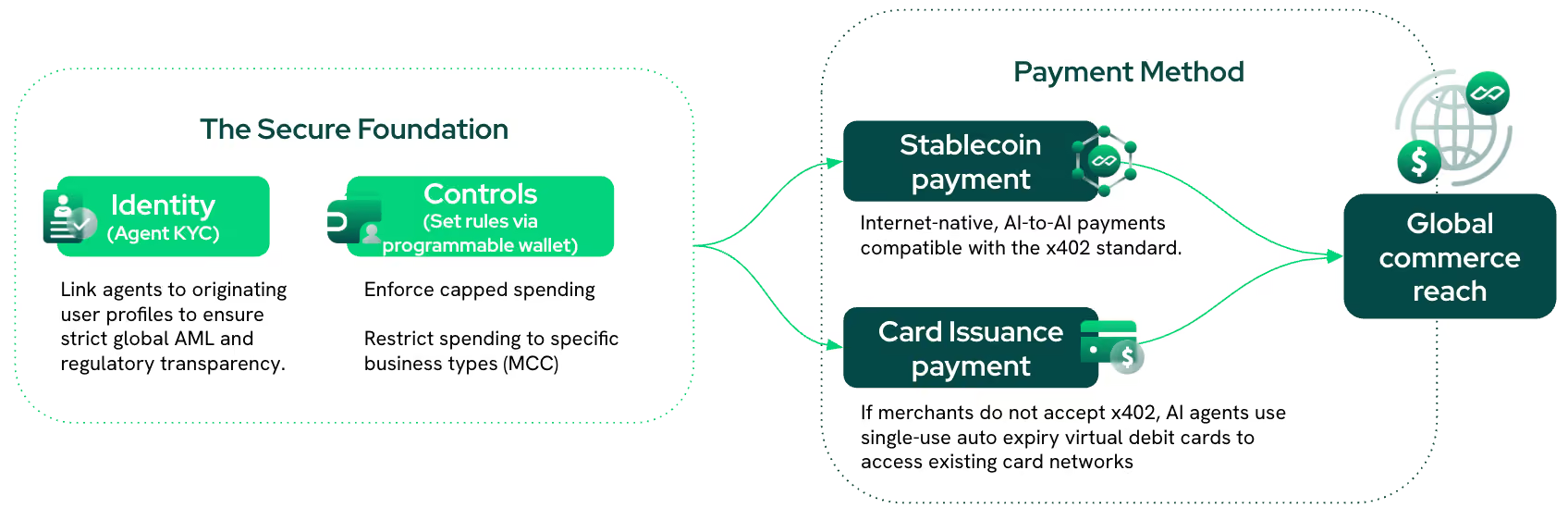
The fastest path to adoption is not requiring merchants to change systems, but enabling agents to use existing payment methods already accepted by merchants, including cards, QR payments, and digital wallets.
This approach allows agentic payments to scale on top of existing networks such as GrabPay and OKX Pay. Partnerships such as StraitsX’s integrations with Grab and KBank demonstrate this model, enabling users to pay with stablecoins while merchants receive fiat settlement without handling digital assets. At scale, global networks like Visa’s 175M+ merchant acceptance footprint highlight why leveraging existing rails is critical for adoption.
Agentic payments will be multi-rail, with agents dynamically selecting between cards, QR payments, bank transfers, stablecoin rails, and future agent-native protocols depending on transaction context.
Operational implications in practice
Cross-border payments today require coordination across FX, settlement, compliance, and payment collection systems. Each layer introduces dependencies that must be manually managed.
Under an agentic model, these can be abstracted into higher-level intent-based actions, where systems determine the optimal execution path. This reduces operational burden during integration, without removing underlying complexity.
Relevance for Southeast Asia
Southeast Asia’s financial systems are fragmented across currencies, regulations, and payment rails. Agentic systems introduce abstraction that helps standardise integration across markets while adapting to local requirements. This reduces incremental effort for regional expansion and improves scalability while maintaining compliance.
Core Capabilities of Agent-Compatible Infrastructure
Agentic payments require infrastructure that is structured, compliant, and executable by autonomous systems interacting with identity systems, ledger balances, and payment rails within controlled boundaries.
Programmable money with embedded constraints
Funds must be controlled not only in movement but also in usage. Programmable money enables capital to be issued with predefined spending rules. For AI agents, this enables scoped execution of tasks such as payments, procurement, or disbursements while remaining aligned with user intent.
Agentic wallets must be ring-fenced and permissioned, with pre-funded balances, spending limits, and tiered approval based on transaction risk. For example, low-value transactions can be auto-approved within limits, while high-value transactions require stronger authentication or additional checks such as KYC.
Always-on settlement infrastructure
AI agents operate continuously, requiring 24/7 settlement infrastructure that eliminates banking-hour constraints and enables instant execution and clearing.
Operating within regulatory frameworks
As agents take on more financial responsibility, compliance must be embedded at the infrastructure layer. Licensed and regulated foundations ensure auditability, custody controls, and legal compliance for machine-initiated transactions.
Looking ahead
As AI adoption accelerates, infrastructure that is fragmented or manual will become increasingly limiting. Systems that are composable, structured, and machine-readable will better support future development models.
At StraitsX, we continue building agent-compatible infrastructure, improved documentation, and expanded regional capabilities.
Get started
As development workflows evolve, infrastructure must evolve with them.
Organisations in fintech, digital assets, and embedded finance will benefit from systems that reduce integration complexity while supporting scale and flexibility.
Contact our team to learn how StraitsX can support your business as we progress toward the agentic economy.

.avif)