
The New Era of Money Movement: How Stablecoins are Solving Global Cross-Border Friction
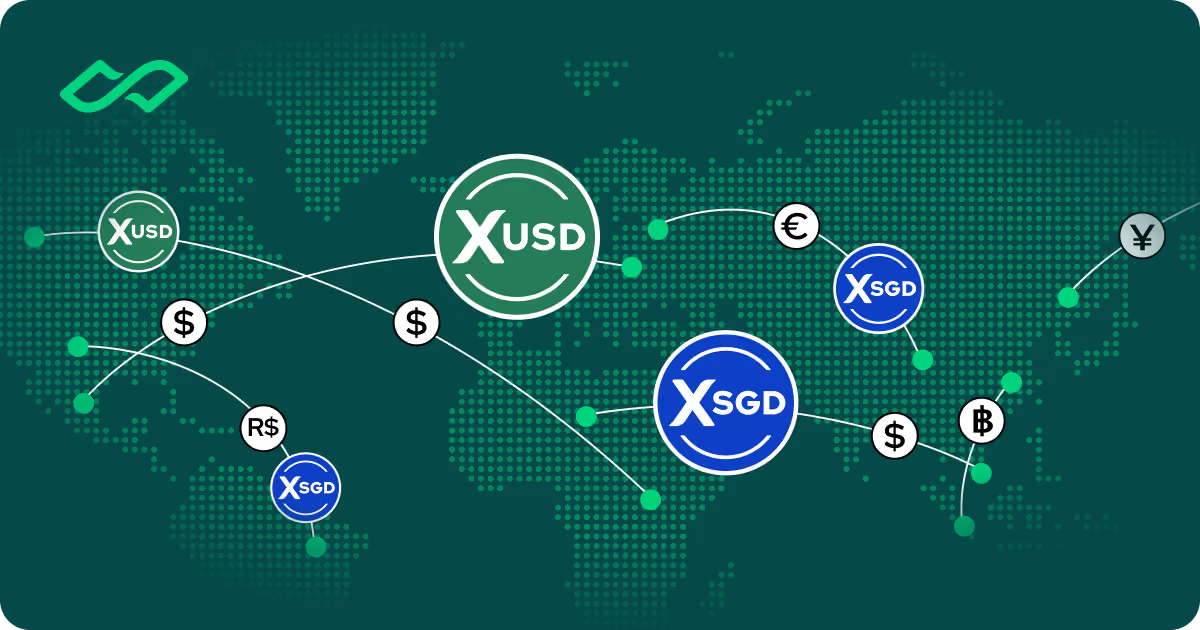
In 2025, moving value globally has reached a tipping point. Stablecoins have transitioned from early-stage pilots to a foundational settlement layer for the digital economy, now processing over US$33 trillion in annual volume. For global institutions and businesses, this shift isn't just about a new payment method. It is a strategic migration toward a 24/7 financial architecture that matches the speed of the internet.
The Hidden Costs of Traditional Global Payments
While digital storefronts have evolved at breakneck speed, the underlying infrastructure for international B2B payments has struggled to keep pace. Most global transfers still rely on the traditional banking rails that are dependent on the corresponding banking system, which remains plagued by three critical points of friction:
- The Liquidity Gap: In a traditional SWIFT-based transfer, funds are often "trapped" in transit for 3 to 5 business days across multiple intermediary banks. This forces treasury teams to maintain significant cash buffers, tying up working capital that could be deployed for growth.
- Hidden Fee Cascades: Between sending banks, intermediary "hop" banks, and receiving institutions, a single global payment can lose up to 6% of its value in layered service fees and opaque FX markups.
- Opaque Settlement Tracking: Until a payment arrives, both the sender and the beneficiary are often left in the dark, leading to reconciliation delays and manual intervention.
Stablecoins: A Unified, Instant Settlement Tool
Stablecoins like XSGD and XUSD act as a universal bridge for value, enabling businesses to bypass the slow, multi-layer paths of traditional finance.
- Near-Instant Finality: On high-performance blockchain networks like Solana, Polygon, or Arbitrum, stablecoin transactions settle in seconds. In 2026, this infrastructure provides 24/7/365 liquidity, ensuring payments flow even on weekends and holidays when traditional banks are closed.
- Programmable FX & Treasury: Stablecoins allow users to lock in exchange rates in real-time through smart contracts. This eliminates the "FX shock" typical of multi-day transfer periods and allows treasury teams to position liquidity closer to on-demand needs.
- On-Chain Traceability: Every stablecoin transaction is logged on a transparent ledger, so treasury teams have a real-time, audit-ready view of every global payout.
Real-World Global Impact: Stablecoin Use Cases in B2B Payouts and Cross-Border Payments
The transition to this high-efficiency infrastructure is already being led by several of the world’s largest industry giants.
1. Amazon & Tokenised Supplier Settlement
In a landmark collaboration, Amazon worked with StraitsX and NTT Digital to pilot the use of stablecoins for tokenised accounts payable.
- The Use Case: Traditionally, global sellers wait up to 14 days for payouts to clear. This partnership explored tokenising those payables, allowing sellers to access liquidity and restock inventory almost immediately via stablecoin-native settlement.
- The Global Impact: This shortens the working capital cycle for millions of global vendors, effectively lowering the cost of doing business on the world's largest marketplace.
2. Grab & StraitsX: The Web3-Enabled Regional Corridor
Grab and StraitsX signed a strategic MOU to develop Web3-enabled wallets directly within the Grab app, bringing digital asset wallets and stablecoin settlement into everyday consumer experiences across Asia.
- The Use Case: This initiative will also enable GrabPay merchants across major Asian markets to begin accepting stablecoin payments from both domestic and international consumers via widely used Web3 wallets, while aiming to expand their reach and preserve a familiar digital payment experience for both merchants and consumers.
- The Global Impact: By uniting Grab’s scale with StraitsX’s infrastructure, they’ve created a blueprint for how stablecoins can unify fragmented payment systems across entire continents into a single interoperable framework.
3. Visa: Breaking Through to Institutional Settlement
By 2026, Visa expanded its stablecoin settlement layer significantly, processing over US$3.5 billion in annualised volume.
- The Use Case: Visa now allows institutional partners to settle their obligations in USDC directly over the Solana blockchain.
- The Global Impact: This has moved global settlement from a "business days only" schedule to a continuous operation, improving speed and reducing collateral requirements for banks and fintechs globally.
4. Global B2B Payout Platforms: Stripe
Global payment providers like Stripe have integrated stablecoins to power international B2B payouts through Stripe Connect.
- The Use Case: Businesses use these platforms to pay global contractors and freelancers instantly. Instead of a $30 bank wire fee, a platform can send USDC with a lower gas fee.
- The Global Impact: This enables a more agile global workforce, ensuring that even workers in complex corridors receive their full earnings without the friction of traditional cross-border bank fees.
Powering Your Global Payments with StraitsX
For businesses looking to lead in 2026, the various StraitsX stablecoin solutions act as the essential bridge between traditional systems and digital liquidity. We handle the complexity of the "on-ramp" and "off-ramp," allowing you to convert global fiat into stablecoins securely and at scale.
By adopting a stablecoin-first approach, your business is no longer just sending money, but moving value at the speed of the internet. For more insights on how these tools are being used to optimise cash flow, read our related deep-dive on the real-world use cases of stablecoins and get started today.
.avif)

.avif)
