
.jpg)
Fintechs, digital asset platforms, and other businesses can launch a stablecoin-backed card program by partnering with a regulated card infrastructure provider that connects stablecoin settlement with established payment networks. The right infrastructure brings together card issuing, Visa BIN sponsorship, stablecoin settlement, regulatory compliance, and digital wallet provisioning, within a single platform, providing a foundation for multi-market card programs across APAC, the Middle East, and LATAM, with the flexibility to expand into additional markets over time.
As stablecoin adoption grows, businesses are increasingly exploring how on-chain liquidity can connect with established card networks and merchant acceptance infrastructure. For fintechs and digital asset platforms, stablecoin-backed cards can provide a familiar spending experience while introducing stablecoins into the underlying funding and settlement architecture.
What Is a Stablecoin-Backed Card Program and How Does It Work?
A stablecoin-backed card program allows fintechs and enterprises to issue payment cards that use stablecoins (such as XSGD or XUSD) as the underlying funding source and backend settlement asset. Rather than relying entirely on multi-day correspondent banking channels, the program connects digital wallets directly to global card networks like Visa, using stablecoins as part of the underlying funding and settlement while delivering a standard fiat payment experience to merchants across 175 million global locations.
The underlying architecture operates across two distinct environments:
- The Front-End (Consumer Experience): The end-user sees their balance inside a mobile app or digital wallet and taps their card at any POS terminal worldwide. The merchant receives standard local fiat, maintaining complete process continuity.
- The Back-End (Infrastructure Layer): Behind the scenes, the card infrastructure provider manages the underlying funding, conversion, and settlement processes, which can incorporate stablecoins alongside traditional fiat rails.
For a comprehensive breakdown of stablecoin-backed cards, read our foundational guide on what a stablecoin-backed card is and how it functions.
How to Evaluate the Business Case for a Stablecoin-Backed Card Program?
Evaluating a stablecoin-backed card program requires platforms to assess user demand, regional regulatory feasibility, treasury liquidity, and the total operational investment required. Rather than viewing a card as a standalone feature, platforms analyse how stablecoin settlement improves working capital efficiency, compresses cross-border transaction fees, and boosts user retention compared to traditional card issuing models.
Before choosing to build a stablecoin-backed card, these five core criteria must be considered:
1. Define Primary Product Jobs and Core Use Cases
Defining your card's primary job shapes your underlying funding architecture. Whether your goal is removing off-ramping friction for Web3 users, optimising global marketplace payouts, or streamlining cross-border corporate spend, your core use case dictates how treasury liquidity should be structured.
2. Assess Regional Regulatory Viability
Because stablecoin-backed cards bridge digital asset frameworks with traditional payment laws, platforms must establish clear regulatory pathways in each target market. Working with a regulated infrastructure provider can help establish the compliance, AML, transaction monitoring and settlement controls required for the relevant markets, while program operators remain responsible for their own regulatory obligations.
3. Evaluate Asset Quality and Liquidity
The stablecoins powering your backend clearing must offer transparent reserve backing, institutional liquidity, and 1:1 fiat redemption.
Choosing a card infrastructure provider that also natively issues its own stablecoins, such as StraitsX with XSGD and XUSD, can simplify the settlement architecture by reducing the number of external stablecoin counterparties involved and providing a more integrated path between stablecoin issuance, card funding, and settlement.
This operational model delivers proven results at scale: StraitsX card infrastructure partners achieved an 83-fold increase in issued cards and processed 40-fold of our GTV card volume in 2025 alone, driven by enterprise migration to 24/7 native stablecoin settlement.
4. Decide Whether to Build or Partner
Building an in-house card stack requires securing principal memberships with card networks, constructing real-time conversion engines, managing card tokenisation pipelines, and maintaining multi-jurisdictional compliance teams. Partnering with a specialised provider that delivers an end-to-end and full-stack card solution, combining Visa BIN sponsorship, card issuance, and processing capabilities within a single platform like StraitsX, drastically compresses time-to-market and reduces operational overhead.
5. Plan a Phased Rollout
Testing with a controlled beta group allows you to validate authorisation logic, test just-in-time funding mechanics, and optimise risk controls under real-world conditions before initiating full commercial distribution.
What Are the Essential Steps to Launch a Stablecoin Card Program?
Launching a stablecoin card program involves a structured six-step workflow: defining your funding model, securing BIN sponsorship, establishing compliance frameworks, building authorisation policies, enabling wallet tokenisation, and launching an integrated pilot. Following this blueprint prevents architectural redesigns and regulatory delays during commercial scaling.
Step 1: Select Your Treasury and Funding Architecture
One of the most vital architectural decisions is deciding how on-chain funds become available at the point of sale:
- Pre-funded Model: Card authorisations continuously check a merchant's "Spendable Balance" ledger on the platform, which is backed by centralised deposits
- Just-in-Time (JIT) Funding: Assets remain inside the user's programmable wallet until a card authorisation request is triggered. The infrastructure pulls and converts stablecoins on-demand in real-time.
StraitsX supports both models, allowing platforms to deploy pre-funded accounts or just-in-time liquidity based on their operational requirements and user experience goals.
Step 2: Secure BIN Sponsorship and Network Access
For businesses that are not direct members of a card network, a BIN sponsorship arrangement provides the scheme access and issuing framework required to launch cards on networks such as Visa. Partnering with StraitsX provides Visa BIN sponsorship, card issuing and processing capabilities within an integrated infrastructure stack, allowing businesses to launch card programs without establishing their own direct scheme membership.
Step 3: Embed Compliance, KYC, and Travel Rule Workflows
Card programs are strictly regulated financial products. Your compliance stack must execute identity verification (KYC), sanctions screening, transaction monitoring, and, where applicable, Travel Rule requirements for relevant on-chain transfers.
Step 4: Configure Programmatic Authorisation Rules
Modern cards allow businesses to enforce granular spend policies. Platforms can configure authorisation engines to restrict specific Merchant Category Codes (MCCs), set velocity limits, or grant custom permissions for AI agents and corporate employees.
Step 5: Provision Digital Wallets and Wearables
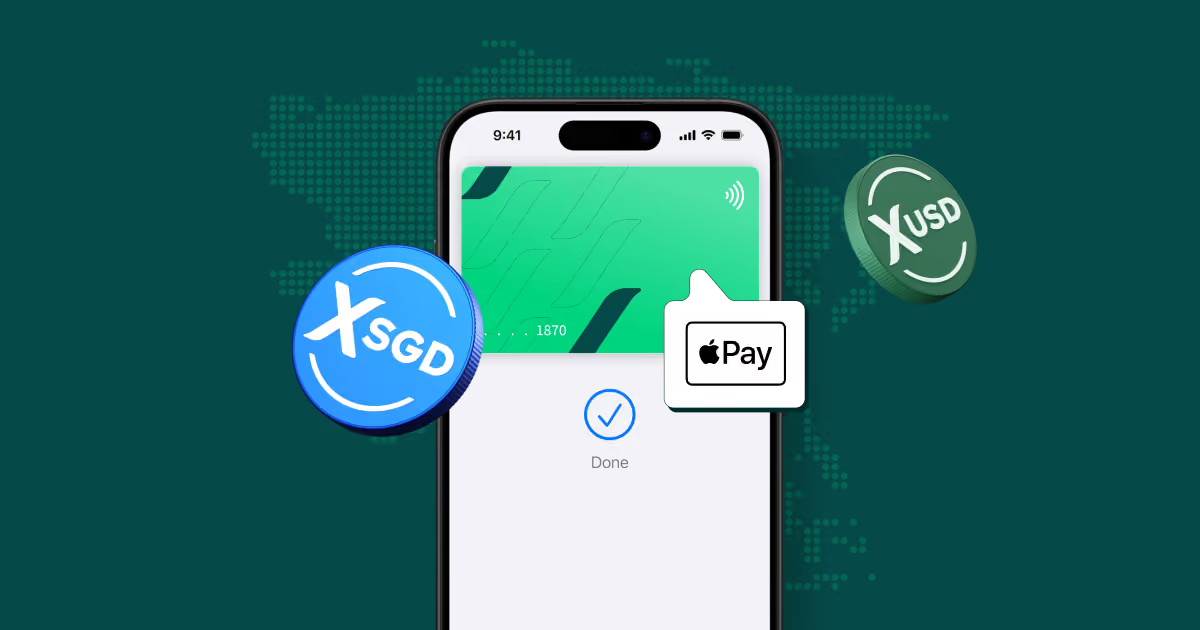
Physical cards are no longer the only expected form factor for consumer payment programs. End-users increasingly expect cards to be available through mobile wallets and wearable devices. Enabling certified wallet provisioning allows users to add virtual cards directly into Apple Pay, Google Pay, and Samsung Pay upon account approval.
For card programs targeting mobile-first markets, wallet provisioning should therefore be evaluated as part of the initial infrastructure decision, rather than treated as a post-launch feature.
For step-by-step technical instructions on provisioning virtual cards into mobile wallets, read our guide on how to enable Apple Pay, Google Pay, and Samsung Pay for your card program.
Step 6: Execute Controlled Pilot Testing
Before initiating a commercial rollout, platforms execute a controlled pilot phase to stress-test authorisation logic, refund handling, edge-case declines, and backend stablecoin-to-fiat settlement flows.
StraitsX maintains strict pilot guardrails, including whitelisted testing devices, capped transaction limits, restricted internal card counts, and short validity periods to ensure complete environment security.
Why Is Sourcing Global Infrastructure Without Starting Over in Every Market Critical?
Sourcing global card infrastructure without starting over in every market is critical because standard card issuing forces platforms to negotiate separate banking relationships, rebuild compliance stacks, and reintegrate local processors for each target country. Expanding internationally under this card issuance model typically creates severe operational friction:
- Sourcing New Issuers: Teams must identify and negotiate with new sponsor banks in each country or region.
- Rebuilding Compliance: Risk and KYC engines must be redesigned to meet fragmented localised standards.
- Reintegrating Settlement Rails: Treasury teams must manage complex local bank pre-funding pools, absorbing longer timelines, higher overhead, and elevated operational complexity.
A unified, cross-border stablecoin settlement layer can reduce some of this regional fragmentation. By utilising stablecoin rails for backend clearing, platforms replace localised banking silos with a cohesive digital dollar settlement framework. A unified infrastructure layer can reduce the need to rebuild parts of the technical and settlement architecture as programs expand, although regulatory, scheme and local market requirements still need to be addressed in each jurisdiction.
Why Choose StraitsX as Your Stablecoin-Backed Card Issuing Partner?
StraitsX combines regulated stablecoin issuance, Visa BIN sponsorship, card issuing and processing, and settlement infrastructure within a single platform. The architecture is designed for businesses that prioritise regulatory alignment, programme control, wallet compatibility, and sustainable multi-market expansion.
For businesses looking to scale beyond a single country, StraitsX's decade of experience in payments infrastructure in Asia provides a resilient foundation for multi-market card programs:
- Regulated Infrastructure & Compliance: StraitsX is licensed and regulated by the Monetary Authority of Singapore (MAS) as a Major Payment Institution (MPI). Designed around regulatory requirements, our infrastructure provides institutional-grade AML, transaction monitoring, and settlement governance controls.
- Direct Visa BIN Sponsorship & Dedicated BINs: StraitsX provides Visa BIN sponsorship and dedicated BINs as the standard programme setup, giving each card programme its own BIN configuration and greater programme-level control.
- Stablecoin-native settlement: StraitsX is the issuer of XUSD and XSGD, bringing stablecoin issuance and card settlement infrastructure together within one platform. This reduces third-party handling fees and external counterparty risks while supporting additional third-party stablecoins including USDC.
- Certified Mobile & Wearable Tokenisation: Integrated issuing and processing on one platform supports certified wallet provisioning for Apple Pay, Google Pay, and Samsung Pay, complete with In-App Provisioning support and tokenised wearable integration (rings, watches, and other supported devices).
- Proven Deployments: Powering major regional platforms including OKX, RedotPay, UPay, Chocolate Finance, Tevau, and Pionex, StraitsX processed over 40-fold of our GTV card volum in card volume in 2025 with a typical deployment timeline of 12 to 14 weeks.
Ready to Launch Your Branded Card Program in Asia and Beyond?
Expanding your platform globally does not require starting over in every market. By leveraging StraitsX’s stablecoin-native settlement layer, your business can deploy a secure, compliant card program that scales efficiently across borders.
Contact the StraitsX sales team today to explore custom card issuance solutions for your platform.
Frequently Asked Questions
What is the difference between a BIN sponsor and a card processor?
A BIN sponsor provides the regulatory authorisation and financial network membership needed to issue cards on networks like Visa, while a card processor handles the technical routing, authorisation messages, and ledger calculations for each transaction. StraitsX full-stack card solutions integrate both BIN sponsorship and card issuance & processing on a single API integration.
Do merchants need to accept stablecoins to receive payments from these cards?
No, merchants receive standard local fiat currency at their existing POS terminals. StraitsX executes the stablecoin settlement and fiat conversion behind the scenes, ensuring full compatibility with existing Visa network infrastructure.
What is the advantage of receiving a dedicated BIN by default?
A dedicated BIN gives your card program its own BIN configuration rather than sharing one across multiple programs. This provides greater control over program configuration, transaction management, and future scaling, while giving the program a more distinct operational setup.
What mobile wallets and wearables are supported?
StraitsX supports certified wallet provisioning for Apple Pay, Google Pay, and Samsung Pay, including In-App Provisioning and tokenised smart wearables like rings and watches.
Which stablecoins can be used for backend program settlement?
Programs can settle using StraitsX native stablecoins (XSGD and XUSD) as well as supported third-party stablecoins including USDC.
How does stablecoin settlement reduce operational complexity for global expansion?
By settling backend clearing obligations on-chain 24/7, platforms avoid opening separate bank pre-funding accounts in every new country, enabling multi-market operations through a single treasury framework.
.avif)
